
Affiliate Disclosure
HVAC Guide Guys is a participant in the Amazon Services LLC Associates Program, an affiliate advertising program designed to provide a means for sites to earn advertising fees by advertising and linking to Amazon.
Ever wondered how to unlock the secret code of your air conditioning system’s cooling capacity? What if finding your HVAC unit’s tonnage was easier than you thought? Discovering the right AC tonnage can save you money, improve home comfort, and prevent unnecessary energy waste.
Finding AC tonnage doesn’t require an engineering degree. Whether you’re a homeowner looking to understand your cooling system or preparing for a replacement, this guide will walk you through five simple methods to determine your HVAC unit’s precise cooling capacity.
AC tonnage describes the cooling capacity of your system and plays a key role in maintaining home comfort. A correctly sized unit ensures efficient cooling. It also prevents unnecessary energy consumption and possible system damage.
Key Takeaways
- Tonnage measures cooling capacity, not physical weight
- Multiple methods exist to determine your HVAC unit’s size
- Proper sizing impacts energy efficiency and home comfort
- Model numbers and manufacturer labels provide essential information
- Professional consultation can provide precise measurements
Table of Contents
Understanding HVAC Tonnage and Why It Matters
Keeping your home cool is all about knowing AC unit tonnage. It’s key for comfort and saving energy. This term might seem odd, but it’s important in air conditioning history.
What Does AC Tonnage Mean
AC unit tonnage shows how much cooling your air conditioner can handle. One ton can cool 2,000 lbs of water in 24 hours. This equals 12,000 BTU per hour. It comes from the old days when ice was used for cooling.
- 1 ton = 12,000 BTUs per hour
- 2 ton = 24,000 BTUs per hour
- 3 ton = 36,000 BTUs per hour
The Relationship Between BTUs and Tons
A BTU (British Thermal Unit) is the heat needed to warm one pound of water by one degree Fahrenheit. Knowing this helps pick the right AC size for your home.
Why Proper Sizing Is Critical for Your System
Choosing the right AC tonnage is essential for comfort and system life. Big units waste energy and wear out faster. Small units can’t cool well and work too hard.
Precision matters more than size when it comes to air conditioning.
How to Find Tonnage of HVAC Unit Using the Model Number
Finding your air conditioning unit’s tonnage is easy. Just follow a few steps to uncover your HVAC system’s capacity from its model number.
Locating Your Outdoor Condensing Unit
Your condensing unit is the outdoor part of a split-system AC. It’s a box-shaped metal cabinet on a concrete pad. You’ll find it on your property’s side or rear. Look for a strong, rectangular metal box with wires and refrigerant lines.
Reading the Data Plaque or Manufacturer Label
Every condensing unit has a data plaque or sticker. It’s on the unit’s side and has lots of important info. The model number is key to knowing your unit’s tonnage.
Decoding the Two-Digit Number in Your Model
The model number has a two-digit number for BTU capacity. Here’s how to find your AC’s tonnage:
- Find the two-digit number between 18 and 60 on the model number
- Make sure the number is even
- Divide the number by 12 to find tonnage
Example: For model 4TTZ0048A1000AA, the two-digit number is “48”:
- 48,000 BTUs per hour
- 48 ÷ 12 = 4-ton unit
Pro Tip: Different manufacturers may have slightly varying model number formats, but the basic principle of dividing by 12 remains consistent.
Explore Our HVAC Shop
Looking for top-rated HVAC tools, parts, and accessories? Visit our shop and find the perfect solution for your needs.
Visit the ShopMethod One: Calculate Tonnage from the Model Number
Finding your HVAC unit’s tonnage from its model number is easy. Most homeowners can do it themselves. The unit’s BTU capacity is usually hidden in the model number.
To find your AC unit’s tonnage, follow these simple steps:
- Locate the outdoor condensing unit
- Find the complete model number on the data plate
- Identify the two-digit number in the model string
- Divide that number by 12 to calculate tonnage
The two-digit number you’re looking for is between 18 and 60. This number shows thousands of BTUs. Most big HVAC makers use this system.
| Model Number | BTUs | Tonnage |
|---|---|---|
| 18 | 18,000 | 1.5 tons |
| 24 | 24,000 | 2 tons |
| 30 | 30,000 | 2.5 tons |
| 36 | 36,000 | 3 tons |
| 42 | 42,000 | 3.5 tons |
| 48 | 48,000 | 4 tons |
| 60 | 60,000 | 5 tons |
Pro tip: If the model number is hard to read, take a clear photo. Zoom in to see it better. Sometimes, lighting or wear can make it hard to read.
Keep in mind, this method works for most units. But, some makers might use different codes. If unsure, check the maker’s guide or ask an HVAC expert.
Method Two: Use the BTU Rating on Your Unit
Knowing the BTU rating is key to figuring out your HVAC unit’s size. The BTU rating shows how much heat a unit can take out in an hour. This makes it easy to know how big your air conditioner is.
Finding the BTU Capacity
Finding the BTU rating is easy. You can find it on:
- The unit’s data plaque
- Manufacturer specification sheets
- Original installation documentation
Converting BTUs to Tons
Changing BTUs to tons is simple. One ton is 12,000 BTUs per hour. To get the tonnage, just divide the BTU rating by 12,000.
Here are some quick examples:
- 18,000 BTUs ÷ 12,000 = 1.5 tons
- 24,000 BTUs ÷ 12,000 = 2 tons
- 30,000 BTUs ÷ 12,000 = 2.5 tons
- 48,000 BTUs ÷ 12,000 = 4 tons
This method is great for older units or when looking at spec sheets. The data plaque lists BTU capacity and other important details. It’s a top tool for figuring out your HVAC system’s size.
Method Three: Measure Your Home’s Square Footage
Knowing your home’s square footage is key to picking the right HVAC size. But, square footage alone isn’t enough. Other factors also play a big role.
The usual rule is about 20 BTUs per square foot for cooling. This gives a quick guess. Yet, it’s not always right. Many things can change your cooling needs.
- Measure the total square footage of your living space
- Multiply the square footage by 20 BTUs
- Divide the result by 12,000 to determine estimated tonnage
For example, a 2,000-square-foot home would be:
(2,000 × 20) ÷ 12,000 = 3.33 tons. So, a 3.5-ton unit might be best.
| Home Size | Estimated BTUs | Approximate Tonnage |
|---|---|---|
| 1,500 sq ft | 30,000 BTUs | 2.5 tons |
| 2,000 sq ft | 40,000 BTUs | 3.5 tons |
| 2,500 sq ft | 50,000 BTUs | 4.0 tons |
A Manual J load calculation is the best way to size your HVAC. It looks at important things like:
- Insulation levels
- Number and size of windows
- House orientation
- Local climate conditions
- Number of occupants
- Heat-generating appliances
Online BTU calculators can give good guesses. But, a pro’s advice is better. For a new HVAC, get an expert’s help for the best fit and efficiency.
Explore Our HVAC Shop
Looking for top-rated HVAC tools, parts, and accessories? Visit our shop and find the perfect solution for your needs.
Visit the ShopMethod Four: Check Manufacturer-Specific Model Number Patterns
Decoding your HVAC unit’s model number can reveal critical information about its tonnage. Different manufacturers use unique coding systems. These systems help you identify the unit’s capacity quickly and accurately.
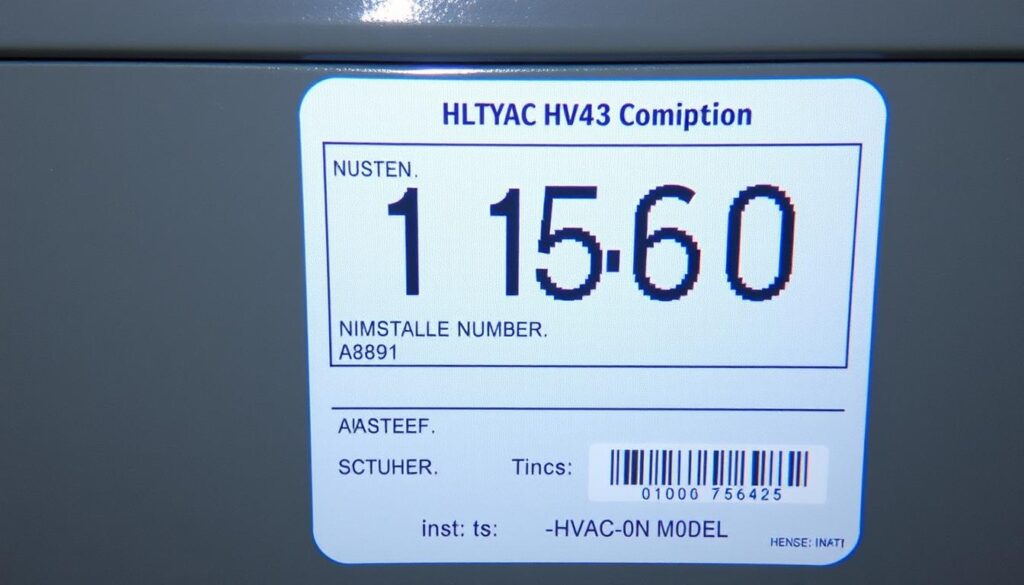
Understanding these manufacturer-specific patterns can save you time. It also provides precise insights into your system’s specifications. Let’s explore how various brands encode their unit sizes.
Trane Model Number Decoding
For Trane units like the YCD180F, the process is straightforward. The BTU is truncated to 180, which means 180,000 BTUs. When you divide 180 by 12, you get a 15-ton unit. Trane’s model numbers often embed specific sizing information within their alphanumeric codes.
- Look for the first set of digits in the model number
- Divide the BTU value by 12 to determine tonnage
- Verify the calculation with the unit’s specifications
Carrier and Bryant Tonnage Codes
Carrier and Bryant have their own unique approach. For instance, the Bryant 574D030 model has a BTU truncated to 30, indicating a 2.5-ton unit. The Carrier 48TC16 represents a 15-ton unit, directly referencing tonnage.
“Knowing your manufacturer’s coding system can unlock quick and accurate system sizing information.”
York and Other Brand Designations
York units like the ZX04 typically represent a 3-ton unit. Some manufacturers round up tonnage for 2.5, 7.5, and 12.5-ton units. This makes their model numbering system simpler.
Remember that while these patterns are generally reliable, consulting a professional HVAC technician can provide the most accurate assessment of your unit’s specifications.
Method Five: Consult a Professional HVAC Technician
Struggling to figure out your HVAC unit’s tonnage? A professional HVAC technician is your go-to. They can find the right size for your space and show you top-notch options.
Technicians are key in certain situations:
- Labels are unreadable due to weather damage
- You have uncommon or commercial equipment
- Your home has unique architectural features
- Significant renovations have occurred
- Performance issues suggest sizing problems
During a detailed on-site check, they do important work:
- Manual J load calculations
- Ductwork condition and sizing analysis
- Insulation and air sealing inspection
- Comfort preference evaluation
- Recommendations based on current efficiency standards
Professional checks ensure top performance and consider all size factors. A thorough assessment might cost $100-$300. But it avoids costly mistakes in choosing equipment.
When picking a technician, look for:
- Proper licensing
- NATE certification
- Manufacturer-specific training
- Positive customer reviews
Pro tip: Always ask detailed questions about their sizing methodology and request explanations of their recommendations.
Common Tonnage Sizes and Their BTU Equivalents
Choosing the right air conditioning tonnage for your home can save money and boost comfort. AC units come in different sizes for various home sizes. Knowing the AC tonnage conversions helps you pick the best HVAC system.
Standard Residential AC Unit Sizes
Home cooling needs differ based on several factors. Here are the most common residential AC unit sizes:
- 1.5 tons (18,000 BTUs): Best for small homes or apartments (600-1,000 sq ft)
- 2 tons (24,000 BTUs): Ideal for modest homes (1,000-1,300 sq ft)
- 2.5 tons (30,000 BTUs): Suitable for average-sized homes (1,300-1,600 sq ft)
- 3 tons (36,000 BTUs): Perfect for larger homes (1,600-1,900 sq ft)
- 3.5 tons (42,000 BTUs): Great for spacious homes (1,900-2,200 sq ft)
- 4 tons (48,000 BTUs): Handles large homes (2,200-2,600 sq ft)
- 5 tons (60,000 BTUs): Cools very large residences (2,600-3,200 sq ft)
Quick Reference Conversion Chart
Use this quick guide to match your home’s size with the right AC tonnage:
| Model Number | BTUs | Tons | Typical Home Size |
|---|---|---|---|
| 18 | 18,000 | 1.5 | 600-1,000 sq ft |
| 24 | 24,000 | 2 | 1,000-1,300 sq ft |
| 30 | 30,000 | 2.5 | 1,300-1,600 sq ft |
| 36 | 36,000 | 3 | 1,600-1,900 sq ft |
| 42 | 42,000 | 3.5 | 1,900-2,200 sq ft |
| 48 | 48,000 | 4 | 2,200-2,600 sq ft |
| 60 | 60,000 | 5 | 2,600-3,200 sq ft |
Note: These guidelines are approximate and can vary depending on climate, home insulation, and other environmental factors.
Explore Our HVAC Shop
Looking for top-rated HVAC tools, parts, and accessories? Visit our shop and find the perfect solution for your needs.
Visit the ShopFactors That Affect Your Required AC Tonnage
Finding the right air conditioning tonnage isn’t just about square footage. Many factors affect how much cooling your home needs. Knowing these helps pick the best HVAC system for your home.
Several key elements affect your AC unit’s needed capacity:
- Sun Exposure: Homes facing south or west need more cooling. Shaded homes use less energy to stay cool.
- Insulation Quality: Good insulation can cut cooling needs by up to 30%. New insulation methods make homes more energy-efficient.
- Number of Occupants: More people mean more heat. A busy home office needs more cooling than an unused room.
Home structure is also important for AC tonnage. Two-story homes cool differently than single-story ones. Ceiling height also matters—taller ceilings mean more air to cool.
“Not all square feet are created equal when it comes to cooling requirements.” – HVAC Professional
- Window types affect heat transfer: Old single-pane windows let in more heat than new double-pane ones.
- Construction type affects how well it keeps heat out
- Climate zone sets the base cooling needs
- Appliances that heat up add to the temperature inside
Professional HVAC techs look at many factors, not just square footage. They make sure you get a cooling system that fits your home perfectly.
Signs Your Current HVAC Unit Is Incorrectly Sized
Choosing the right size for your HVAC unit is key for comfort and saving energy. A system that’s too big or too small can cause many problems. These issues affect your home’s comfort and your utility bills.
Symptoms of an Oversized Air Conditioner
Oversized units have several problems:
- Short cycling (frequent turning on and off)
- Inadequate dehumidification causing cool but clammy spaces
- Uneven temperatures between rooms
- Unusually high energy costs
An air conditioner that’s too big cools spaces fast but doesn’t remove moisture well. This makes your home feel sticky and uncomfortable, even if it’s cool. The constant start and stop wears out your system, shortening its life.
Problems with Undersized Systems
Undersized units face different challenges:
- Constant running without reaching set temperature
- Inability to cool effectively during hot days
- Consistently high energy operating costs
- Frequent repair requirements
An undersized system runs all the time, trying to cool your home but never quite gets there. In the summer, your home might be several degrees warmer than you want it to be.
Spotting these signs early can help you fix sizing issues before you have to replace expensive equipment.
Explore Our HVAC Shop
Looking for top-rated HVAC tools, parts, and accessories? Visit our shop and find the perfect solution for your needs.
Visit the ShopWhen to Replace Your Air Conditioner with a Different Tonnage
Replacing your air conditioner is more than just swapping it out. You don’t need the same tonnage as your old one. Several important factors can change what AC capacity is best for your home.
Home improvements can change how much cooling you need. Think about these changes that might mean you need a different tonnage:
- Better insulation upgrades
- New energy-efficient windows
- Home additions or renovated spaces
- Finished basements or converted living areas
Your current unit might not be the right size. Many contractors used rough estimates instead of precise calculations. This means your current system might not meet your home’s cooling needs.
“Proper sizing is key for comfort, energy efficiency, and system longevity.” – HVAC Professional
Getting a professional Manual J calculation is a good idea when replacing your equipment. This detailed assessment looks at your home’s unique features, including:
- Square footage
- Insulation quality
- Window types and placement
- Local climate conditions
- Home orientation
Spending time on professional load calculations can save you money. It improves comfort, lowers energy bills, and makes your equipment last longer. Don’t rush it – schedule assessments during off-peak seasons for better prices and more detailed checks.
Conclusion
Knowing your HVAC system’s tonnage is more than just a technical task. You’ve learned how to check the model number and convert BTU ratings to tons. These methods help you understand your home’s cooling system better.
Each method has its own benefits. You can estimate square footage or look for specific model number patterns. These approaches help you figure out your system’s capacity.
Getting the sizing right is key for comfort. The wrong size can lead to high energy bills and equipment problems. Whether you’re doing maintenance or planning a new system, choosing the right method is important.
For quick checks, the model number method is great. But for a new system, get professional help for the best results.
Now you know how to make smart choices about your HVAC system. Remember, the best way to know your tonnage is to get a pro to check it. With this knowledge, you can talk to contractors with confidence and know what your home needs.
Do something today. Check your unit’s data plate, book a pro, or use what you’ve learned. Your HVAC system is a big investment. Knowing its tonnage is the first step to better cooling.