
Affiliate Disclosure
HVAC Guide Guys is a participant in the Amazon Services LLC Associates Program, an affiliate advertising program designed to provide a means for sites to earn advertising fees by advertising and linking to Amazon.
How to Determine Size of HVAC Needed for Your Home? Are you tired of uneven temperatures and high energy bills? Finding the right HVAC size for your home might be the answer. Learning how to determine the size of your HVAC is key to comfort and saving energy.
Every home is different, needing its own heating and cooling setup. An HVAC sizing calculator can find the perfect match for your home. The right size prevents overworking your system, cuts down energy use, and keeps your home comfortable.
This guide will show you how to choose the best HVAC system for your home. You’ll learn about square footage, climate zones, and more. You’ll get tips to save thousands on energy costs and avoid costly system replacements.
Key Takeaways
- Correct HVAC sizing is key for comfort and saving energy
- Systems that are too big or too small cost more to run
- Getting a pro to assess your needs is important
- Climate and your home’s features affect HVAC size
- Keeping your system in good shape helps it work better
Table of Contents
Understanding HVAC System Sizing Basics
Getting the right size for your air conditioner is key for comfort and saving energy. Your HVAC system does more than just control the temperature. It’s a complex system that needs accurate sizing to work its best.
Many homeowners miss important details when figuring out the right HVAC size for their home. The size of your air conditioner affects its performance, how long it lasts, and your energy bills.
Why Proper Sizing Matters
Choosing the wrong HVAC size can cause big problems:
- It makes your system less efficient
- It uses more energy
- It can’t cool your home evenly
- It costs more to maintain
Common Sizing Mistakes to Avoid
Homeowners often make big mistakes when picking an HVAC system:
- Oversizing the unit: Bigger isn’t always better
- Just using square footage to decide
- Not considering how well your home is insulated
- Not thinking about your local climate
Impact on Energy Efficiency
Choosing the right HVAC size can really cut down your energy costs. A system that fits your home well works better, uses less electricity, and turns on and off less.
“The right HVAC system is like a perfectly tailored suit—it fits your home’s unique needs precisely.”
Learning about HVAC sizing basics helps you make better choices. This way, you can improve your home’s comfort and save energy.
How to Determine Size of HVAC Needed
Finding the right HVAC size for your house is more than just measuring square footage. It’s about understanding your home’s unique needs. This means looking at several important factors.
- Total square footage of your home
- Local climate conditions
- Home insulation quality
- Number and type of windows
- Ceiling height
- Home’s sun exposure
Experts use a method called Manual J Load Calculation to check your home’s cooling and heating needs. This method is more detailed than just measuring square footage.
| Home Size | Estimated AC Unit Size | BTU Range |
|---|---|---|
| 1000 sq ft | 1.5 tons | 18,000 BTU |
| 1500 sq ft | 2 tons | 24,000 BTU |
| 2000 sq ft | 3 tons | 36,000 BTU |
Choosing the wrong HVAC size can cause higher energy bills, less comfort, and damage to your system. Always talk to a professional for the best fit for your home.
Explore Our HVAC Shop
Looking for top-rated HVAC tools, parts, and accessories? Visit our shop and find the perfect solution for your needs.
Visit the ShopCalculating BTUs for Your Home’s Square Footage
Knowing how to find the right cooling capacity for your home is key for keeping it cool. A btu calculator for home helps you figure out what you need based on your home’s size and details.
Calculating cooling capacity is more than just counting square feet. You must consider several important factors for the best HVAC performance.
BTU Requirements by Room Size
Different rooms need different cooling capacities based on their size and how they’re used. Here’s a basic guide for BTU needs:
- Small bedroom (100-150 sq ft): 5,000-6,000 BTUs
- Medium living room (250-300 sq ft): 8,000-10,000 BTUs
- Large open concept space (400-450 sq ft): 12,000-14,000 BTUs
Total Home BTU Calculation Methods
To find your home’s total BTU needs, multiply its square footage by 20. For instance, a 1,500 square foot home needs about 30,000 BTUs.
Converting BTUs to Tonnage
HVAC experts usually talk about cooling capacity in tons. One ton equals 12,000 BTUs. So, a 30,000 BTU system is a 2.5-ton unit.
Remember, these calculations are just a starting point. Things like insulation, window exposure, and local weather can change your actual cooling needs.
Manual J Load Calculation Overview
When sizing an HVAC system for your home, the manual j calculation is key. It’s more than just square footage. It gives a detailed look at your home’s heating and cooling needs.
The manual j load calculation looks at many important factors:
- Home square footage and layout
- Insulation quality and R-values
- Window types and total glass area
- Local climate zone specifications
- Number of occupants and daily activities
Professional HVAC contractors use this method for accurate system sizing. They look at your home’s details to find the right heating and cooling capacity. This ensures comfort and energy efficiency.
A precise Manual J calculation helps prevent oversized or undersized HVAC systems that waste energy and compromise home comfort.
This method is scientific, unlike simple estimates. It considers heat gain, loss, and environmental factors. It suggests the best HVAC system for your needs.
Getting a professional Manual J assessment can save you money on energy costs. It also prevents system problems in the future.
Climate Zone Considerations for HVAC Sizing
Choosing the right HVAC system is more than just looking at square footage. Your home’s location is key in finding the best cooling capacity. Different climate zones across the United States need unique HVAC sizing approaches.
When using an hvac sizing calculator, consider several regional factors:
- Average summer and winter temperatures
- Humidity levels
- Seasonal temperature extremes
- Geographical elevation
Regional Temperature Variations
Each climate zone has its own cooling and heating challenges. A system perfect for Arizona might not work in Florida’s humid climate. Southern areas often need systems with higher cooling capacities. Northern zones require more robust heating.
Humidity Impact on Sizing
Humidity greatly affects HVAC performance. Coastal and southeastern regions face higher moisture levels. These areas need HVAC units with better dehumidification to keep comfort and prevent mold.
Seasonal Requirements
Your HVAC system must adapt to seasonal changes. A smart sizing strategy considers both summer heat and winter cold. HVAC contractors use special tools to find the right system for your climate zone.
“The right HVAC system is about matching your home’s unique environmental needs.” – HVAC Professional
Home Features Affecting HVAC Size Requirements
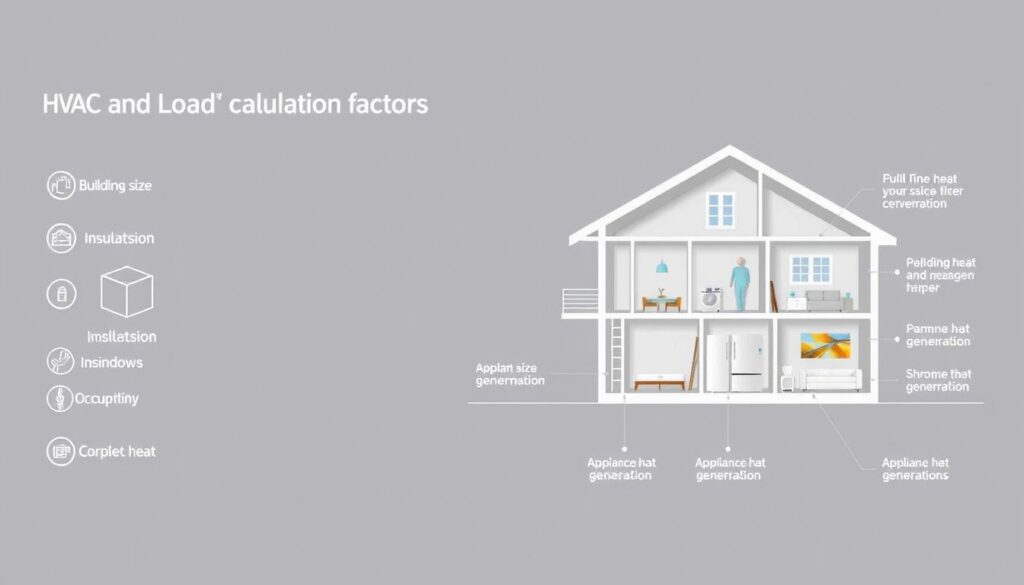
Your home’s unique features are key when figuring out the right size for your air conditioner. Even if two homes are the same size, they can be very different.
Several important features affect how big your HVAC system needs to be:
- Ceiling height
- Number and type of windows
- Home orientation
- Landscaping and surrounding environment
Homes with high ceilings need more cooling because they hold more air. Big windows, and those that get a lot of sunlight, also mean you’ll need a stronger HVAC system.
“Every home is unique, and so are its heating and cooling needs.” – HVAC Professionals
The way your home faces the sun matters a lot. Homes that face south or west get more sun and need stronger cooling systems.
| Home Feature | Impact on HVAC Sizing |
|---|---|
| High Ceilings | Increases cooling capacity needed |
| Large Windows | Raises heat gain |
| Direct Sunlight Exposure | Demands more powerful system |
Knowing these details helps you pick the perfect HVAC system for your home.
Explore Our HVAC Shop
Looking for top-rated HVAC tools, parts, and accessories? Visit our shop and find the perfect solution for your needs.
Visit the ShopInsulation’s Role in HVAC System Sizing
Insulation is key to understanding how to size your home’s heating system. It acts as a thermal barrier, affecting your system’s efficiency and performance.
Good insulation can make your HVAC system work less hard. This might let you use a smaller, more efficient unit. The secret to great insulation is knowing its R-value.
R-Value Assessment
R-value shows how well insulation stops heat flow. The higher the R-value, the better the insulation. When sizing your HVAC, experts look at these R-value ranges:
- Attic insulation: R-38 to R-60
- Wall insulation: R-13 to R-21
- Basement/crawl space: R-10 to R-15
Window and Door Considerations
Windows and doors can let heat in or out. Energy-saving windows and tight seals can greatly cut down on heat loss. This helps you size your HVAC system better.
| Window Type | R-Value | Heat Loss Reduction |
|---|---|---|
| Single-pane | R-1 | Low |
| Double-pane | R-2 to R-3 | Moderate |
| Triple-pane | R-4 to R-5 | High |
Attic Insulation Impact
Your attic is vital for keeping your home at a good temperature. Adding more attic insulation can cut HVAC load by up to 20%. This means you can have a system that’s just the right size and works better.
Single-Stage vs Two-Stage HVAC Systems
Understanding the difference between single-stage and two-stage HVAC systems is key. Single-stage systems run at full power all the time. Two-stage systems offer better temperature control.
Two-stage HVAC systems have many benefits:
- More precise temperature regulation
- Enhanced energy efficiency
- Improved humidity control
- Reduced operational noise
The main difference is in how they work. Single-stage systems always run at 100% capacity. They turn on and off a lot. Two-stage systems can run at low and high speeds. They adjust to your home’s cooling needs.
| Feature | Single-Stage System | Two-Stage System |
|---|---|---|
| Operational Modes | Full Capacity Only | Low and High Speed |
| Energy Efficiency | Lower | Higher |
| Temperature Control | Less Precise | More Precise |
“Choosing the right HVAC system is about balancing comfort, efficiency, and your specific home’s requirements.” – HVAC Professional
When picking between these systems, think about your home’s needs. Two-stage systems might need a different approach to sizing. They could offer more flexible options.
Professional HVAC Size Assessment Methods
Choosing the right HVAC system for your home is more than just numbers. A detailed hvac sizing calculator needs expert skills. These skills give you exact measurements and insights into your home’s heating and cooling needs.

Experts use advanced methods for accurate system sizing. These methods help homeowners avoid expensive mistakes in heating and cooling.
Energy Audit Insights
An energy audit is a key step in HVAC sizing. Technicians do a thorough check to find out how well your home keeps heat or cool.
- Identify air leakage points
- Evaluate insulation effectiveness
- Measure home’s overall energy efficiency
- Recommend precise manual j calculation strategies
Professional Measurement Techniques
Experts use special tools to get exact data for HVAC sizing. These methods are more detailed than just looking at square footage.
| Measurement Technique | Purpose |
|---|---|
| Blower Door Test | Detect air infiltration and home sealing quality |
| Infrared Thermal Imaging | Identify temperature variations and insulation gaps |
| Duct Leakage Assessment | Evaluate HVAC system distribution efficiency |
“Precision in HVAC sizing isn’t just about numbers—it’s about understanding your home’s unique environmental characteristics.”
By choosing professional assessment, you’ll get an HVAC system that fits your home perfectly. This ensures comfort and saves energy.
Explore Our HVAC Shop
Looking for top-rated HVAC tools, parts, and accessories? Visit our shop and find the perfect solution for your needs.
Visit the ShopUnderstanding HVAC Tonnage Requirements
Choosing the right HVAC system can be tricky. Homeowners often wonder what size AC unit they need. HVAC tonnage shows how much cooling power your system has. One ton is like 12,000 BTUs of cooling power every hour.
To figure out your home’s tonnage needs, you need to consider a few things:
- Square footage of your living space
- Local climate conditions
- Home insulation quality
- Number of windows and their efficiency
- Ceiling height and room layout
Most homes need HVAC systems between 1.5 and 5 tons. A common rule is about 1 ton for every 500-600 square feet. But, this is just a rough guide and not always exact.
Experts use special tools like Manual J load calculation to find the perfect tonnage for your home. They look at more than just square footage. This way, you get an AC unit that fits your home’s specific needs.
Selecting the correct tonnage is key for energy savings and comfort.
Common Signs of Incorrectly Sized HVAC Systems
Knowing if your HVAC system is the right size can save you a lot of money. It also keeps your home comfortable. To size your air conditioner and heating system right, you need to look at a few important signs.
Homeowners should keep an eye out for certain signs that your HVAC system might not be the right size:
- Frequent system cycling on and off
- Uneven temperatures across different rooms
- Unusually high energy bills
- Persistent humidity problems
- Excessive noise during operation
An undersized heating system can’t keep your home warm, so it runs a lot and uses more energy. On the other hand, an oversized system has its own problems:
| Oversized System Symptoms | Impact |
|---|---|
| Short cycling | Increased wear and tear |
| Rapid temperature changes | Reduced comfort |
| Higher energy consumption | Increased utility costs |
Spotting these signs early can help you fix your heating system sizing issues. Getting a professional HVAC check can give you the exact measurements you need for the best system performance.
Proper HVAC sizing is not just about comfort—it’s about maximizing efficiency and minimizing long-term costs.
If you see many warning signs, it’s time to call an HVAC expert. They can do a detailed check of your home’s heating and cooling needs.
Conclusion
Figuring out the right size for your HVAC system is key to comfort and saving energy. The right system can make your home cozy and keep your bills low.
Calculating the HVAC load involves many factors. These include your home’s size, climate, insulation, and design. Experts use special methods to find the perfect fit for your home, avoiding mistakes.
Choosing the right HVAC size is important. A system that’s too big or too small can waste energy and cost more. This guide helps you make smart choices for your home’s comfort and your wallet.
Don’t skip the step of talking to certified HVAC pros. They’ll check your home’s needs carefully. This ensures your HVAC system is just right, bringing you comfort and savings.