Affiliate Disclosure
HVAC Guide Guys is a participant in the Amazon Services LLC Associates Program, an affiliate advertising program designed to provide a means for sites to earn advertising fees by advertising and linking to Amazon.
Are you ready to unlock the secrets of creating perfect indoor environments? What if you could master the technical art of designing systems that keep people comfortable in any building?

HVAC design is a dynamic engineering field. It turns mechanical principles into comfortable living and working spaces. Learning HVAC design needs dedication, technical understanding, and a passion for solving complex environmental challenges.
This guide will show you the essential steps to become a skilled HVAC design professional. Whether you’re a student, technician, or career changer, you’ll find the roadmap to expertise in HVAC design fundamentals and engineering courses.
The HVAC industry offers exciting opportunities for those willing to invest in their technical education. It’s about understanding the science behind heating, ventilation, and air conditioning systems.
Key Takeaways
- HVAC design combines mechanical engineering with practical environmental solutions
- Technical skills are critical for successful system development
- Multiple educational pathways exist for aspiring HVAC designers
- Understanding thermodynamics is key for advanced system design
- Career opportunities span residential, commercial, and industrial sectors
Table of Contents
Understanding What HVAC Design Really Means
HVAC design is more than just heating and cooling. It’s a complex process that affects every modern building. It deals with thermal comfort and air quality.
HVAC design focuses on creating systems that keep indoor spaces comfortable. These systems do more than just control temperature. They ensure comfort, health, and productivity for everyone inside.
The Core Components of HVAC Systems
To understand HVAC systems, you need to know their key parts. The main components are:
- Refrigerant circulation systems
- Evaporator and condenser coils
- Compressors that manage pressure and temperature
- Heat exchangers for efficient energy transfer
- Comprehensive ductwork networks
- Advanced ventilation equipment
“HVAC design transforms raw mechanical components into intelligent environmental control systems.” – ASHRAE Engineering Guide
Why HVAC Design Skills Matter in Today’s Market
The need for skilled HVAC designers is growing fast. Buildings use about 40% of the U.S. energy. Experts in energy-efficient systems are very important.
Your skills can help a lot:
- Lowering costs
- Reducing environmental impact
- Improving air quality
- Using smart building tech
HVAC design pros lead in making buildings smarter and more efficient. They play a key role in sustainability and innovation.
Essential HVAC Design Fundamentals You Need to Master
Learning hvac design basics is key for those in HVAC engineering courses. You start by grasping essential principles. These principles turn complex systems into efficient comfort solutions.
The heart of good HVAC design lies in three main areas:
- Thermodynamics: Getting how energy and heat move
- Fluid Mechanics: Studying air and liquid flow in systems
- Heat Transfer: Figuring out how thermal energy moves between places
Your HVAC system’s success depends on managing thermal dynamics well. You must know how buildings affect heating and cooling needs. This includes looking at:
- Insulation quality
- Window performance
- Air infiltration rates
- Thermal mass characteristics
Knowing psychrometrics is vital for HVAC design. Understanding humidity control and human comfort zones makes you stand out.
Getting system sizing right is also key. A system that’s too big wastes energy by cycling too much. A system that’s too small can’t keep temperatures comfortable. Your aim is to find the perfect balance through smart calculations and design.
Effective HVAC design turns engineering into comfortable, energy-saving spaces.
Explore Our HVAC Shop
Looking for top-rated HVAC tools, parts, and accessories? Visit our shop and find the perfect solution for your needs.
Visit the ShopLearning the Principles of Heat Transfer and Thermodynamics
Understanding heat transfer is key in hvac design. It shows how we manage temperature and comfort. Heat moves through three main ways that shape HVAC designs.
Knowing these principles helps you make better thermal management solutions.
Conduction, Convection, and Radiation Basics
Heat transfer happens in three main ways:
- Conduction: Heat moves through solid materials like walls and floors
- Convection: Heat transfers through fluid movement in air or water
- Radiation: Heat transfers via electromagnetic waves
Each method is important for understanding how heat moves in buildings.
Applying Thermodynamic Principles to Real-World Systems
Using these principles in real-world designs makes HVAC systems better. You’ll learn to figure out heat transfer rates and understand how equipment works. This is done with key thermodynamic equations.
| Heat Transfer Method | Key Characteristics | HVAC Application |
|---|---|---|
| Conduction | Solid material heat transfer | Insulation design |
| Convection | Fluid movement heat transfer | Air distribution |
| Radiation | Electromagnetic wave transfer | Radiant heating systems |
By grasping these core principles, you’ll get better at designing thermal systems. This skill goes beyond just controlling temperature.
How to Learn HVAC Design Through Structured Education
Learning HVAC design starts with knowing your options. Whether you’re new or looking to grow, there are many ways to learn. Structured education offers paths to master HVAC design basics.
Starting your HVAC engineering journey involves several educational steps:
- Technical Certificate Programs (6-24 months)
- Community College Associate Degrees
- Bachelor’s Degree in Mechanical Engineering
- Online Specialized HVAC Design Courses
Technical schools are a great place to begin. They teach important topics like:
- Thermodynamics principles
- HVAC system components
- Electrical fundamentals
- Refrigeration cycles
- Safety procedures
ASHRAE offers certifications to enhance your skills. Community colleges provide hands-on training with real equipment. This gives you valuable skills for employers.
“Structured education transforms passion into professional expertise in HVAC design.”
Your choice of education depends on your goals. Entry-level techs might get a 6-month certificate. But, if you aim to be a design engineer, a 4-year mechanical engineering degree is best.
Mastering HVAC Load Calculation Techniques
HVAC load calculation is key for designing efficient building systems. Knowing how to find heating and cooling needs is vital. It ensures a space is both comfortable and energy-efficient.
Professionals use special methods for HVAC load calculation. These methods ensure the system is the right size. Many factors affect a building’s heat performance.
Manual J Load Calculations for Residential Buildings
Manual J is a detailed way to calculate load for homes. It looks at important things like:
- Building square footage
- Insulation quality
- Window orientation and efficiency
- Local climate conditions
- Internal heat generation sources
Getting the sizing right is key to avoid wasting energy and ensuring comfort. Proper sizing is essential for the best system performance.
Commercial Load Calculation Methods
Commercial buildings need more advanced load calculation methods. These methods consider:
- Multiple occupancy zones
- Diverse usage patterns
- Complex internal heat loads
- Ventilation requirements
| Calculation Method | Key Characteristics |
|---|---|
| ASHRAE Heat Balance | Accounts for thermal mass effects |
| Radiant Time Series | Evaluates dynamic heat transfer |
| Hourly Analysis | Provides detailed load modeling |
Learning HVAC load calculation takes time and practice. It also requires understanding building science. Using professional software can make these complex tasks easier. It ensures accuracy and follows industry standards.
Explore Our HVAC Shop
Looking for top-rated HVAC tools, parts, and accessories? Visit our shop and find the perfect solution for your needs.
Visit the ShopGetting Familiar with HVAC Design Software and Tools

Starting with HVAC design software can be tough for beginners. Today’s HVAC pros use digital tools to design systems that work well and are precise. Your first step in hvac design software training is to learn about the main software types that lead to new ideas in the field.
The most important tools for HVAC pros are:
- Load Calculation Software: Key for accurate hvac load calculation
- Duct Design Programs
- Equipment Selection Tools
- Energy Modeling Platforms
- CAD and Building Information Modeling (BIM) Software
Software like Wrightsoft Right-Suite and Carrier HAP has lots of features for designers. They help with tough calculations, picking the right equipment, and making detailed project reports with great accuracy.
“Software is a tool that implements your design knowledge, not a replacement for technical understanding.” – HVAC Design Expert
Start your hvac design software training by learning load calculation tools first. These tools are key to designing HVAC systems. They help figure out the exact heating and cooling needs for different areas.
Good places to learn include:
- Manufacturer training programs
- Online tutorials and courses
- Professional organization workshops
- Community forums and user groups
Pro tip: Hands-on practice is key. Start with simple projects and slowly make them more complex to improve your skills.
Understanding Ductwork Sizing and Air Distribution Systems
Ductwork is key to building mechanical systems. Knowing how air flows through it is vital. The right duct size is essential for your heating and cooling system’s performance.
Creating effective air distribution needs careful planning and engineering. You must learn important principles to make ductwork systems that boost comfort and save energy.
Duct Design Principles and Best Practices
Designing ductwork involves several important steps:
- Calculating precise airflow needs
- Understanding friction loss and pressure dynamics
- Picking the right duct materials
- Reducing system resistance
Your ductwork sizing must consider several key factors:
| Factor | Impact on Ductwork Design |
|---|---|
| Airflow Volume | Determines duct cross-sectional area |
| System Pressure | Influences duct material and configuration |
| Space Constraints | Requires creative routing and sizing solutions |
Balancing Airflow for Optimal Performance
Getting air distribution right is all about precision. Balanced airflow ensures every room gets the right amount of air. This prevents hot or cold spots that ruin comfort.
Proper duct design is not just about moving air—it’s about moving air intelligently.
Professional HVAC designers know that building systems need careful attention. Your ductwork is the network for thermal comfort. It requires strategic planning and expert execution.
Studying ASHRAE Standards and Building Codes
Understanding building mechanical systems is key. You need to know ASHRAE standards and building codes well. These rules help make HVAC designs safe and efficient. They ensure your projects meet important performance and safety standards.
The American Society of Heating, Refrigerating and Air-Conditioning Engineers (ASHRAE) offers vital guidelines for HVAC pros. You’ll need to learn about:
- Standard 62.1: Ventilation for Commercial Indoor Air Quality
- Standard 62.2: Residential Ventilation Requirements
- Standard 55: Thermal Comfort Conditions
- Standard 90.1: Energy Efficiency Standards
Getting certified in ASHRAE standards means grasping how they affect building mechanical systems. Each standard covers different HVAC design aspects. This includes ventilation rates and energy efficiency.
“Standards are not just rules, they’re the blueprint for creating safe, comfortable, and efficient building environments.” – HVAC Design Professional
You also need to know about important building codes like the International Mechanical Code (IMC) and International Energy Conservation Code (IECC). These rules cover everything from equipment setup to ventilation requirements.
Keeping up with changing standards is vital. Codes and standards update often to include new tech and research. Your success in HVAC design relies on ongoing learning and adapting.
Explore Our HVAC Shop
Looking for top-rated HVAC tools, parts, and accessories? Visit our shop and find the perfect solution for your needs.
Visit the ShopExploring Commercial HVAC System Design Considerations
Commercial HVAC system design is complex and key to building mechanical systems. Moving from homes to commercial spaces brings big challenges. You need advanced knowledge and special skills.
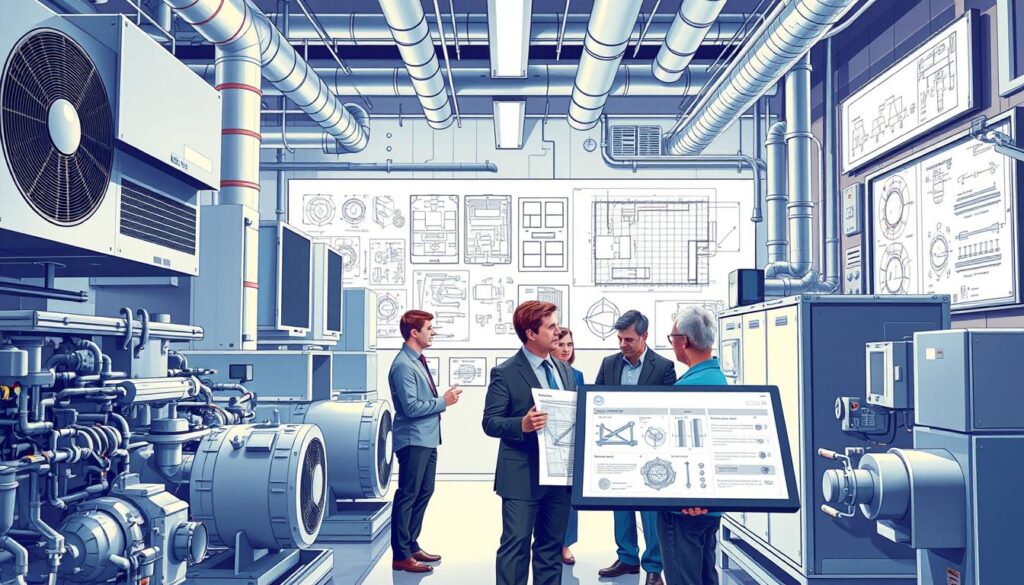
Commercial HVAC design is very different from home systems. You must learn about more complex needs and advanced engineering.
Unique Characteristics of Commercial HVAC Applications
Commercial HVAC systems have unique needs compared to homes. Key differences include:
- Significantly larger equipment capacities
- More complex zoning requirements
- Advanced control systems
- Specialized ventilation needs
Multi-Zone Systems and Complex Building Requirements
Commercial buildings need flexible temperature control across zones. Your design must handle different occupancy, sun exposure, and specific needs.
| System Type | Primary Application | Key Advantages |
|---|---|---|
| Variable Air Volume (VAV) | Large Office Buildings | Energy-efficient zone control |
| Dual-Duct Systems | Mixed-Use Facilities | Independent temperature management |
| Multi-Zone Units | Healthcare Facilities | Precise environmental control |
Designing commercial HVAC systems needs deep knowledge of building mechanics. You also need special engineering skills. The goal is to create flexible, efficient solutions for different spaces.
Developing Energy-Efficient HVAC Design Skills
Energy-efficient HVAC design is key in today’s buildings. You must learn to make systems that save energy and cut costs. These systems should also be good for the environment.
- Understanding efficiency ratings like SEER and AFUE
- Implementing advanced technological solutions
- Optimizing system sizing and performance
- Integrating smart control technologies
Good energy-efficient HVAC design is more than just picking the right equipment. It’s about using smart strategies too. Here are some important points to remember:
- Analyze building envelope characteristics
- Select high-efficiency equipment
- Implement intelligent control systems
- Design for optimal airflow and distribution
| Efficiency Strategy | Potential Energy Savings |
|---|---|
| Variable-speed compressors | 25-40% |
| Smart thermostat integration | 10-15% |
| Proper system sizing | 15-20% |
Using smart HVAC systems with sensors can really help. These systems adjust temperatures and airflow on their own. They also use less energy when not needed.
Professional tip: Think about the whole system, not just parts. Good energy-efficient HVAC design is about the whole picture. It’s about how everything works together to save energy and be efficient.
Gaining Practical Experience in Building Mechanical Systems
Turning your hvac engineering courses knowledge into real-world skills is more than just classroom learning. Practical experience bridges the gap between theory and real-world skills in building mechanical systems.
Getting hands-on in the HVAC industry needs more than one approach to gain experience.
Exploring Apprenticeship Opportunities
Apprenticeship programs are key for those starting in HVAC. They mix practical work with learning, helping you grow your skills.
- Join union-sponsored apprenticeship programs
- Seek technical school partnerships with HVAC contractors
- Apply for entry-level positions as installer’s helper
- Participate in summer internship programs
Learning from Experienced HVAC Engineers
Working with experienced pros turns theory into practical skills. You’ll grasp complex systems better with direct guidance.
- Connect with professionals through ASHRAE networks
- Request informational interviews
- Seek mentorship from consulting engineering firms
- Participate in young engineers professional groups
By mixing education with hands-on training, you’ll get the skills to shine in HVAC design and engineering.
Conclusion
Learning HVAC design is an exciting journey. It combines technical skills, engineering principles, and problem-solving. To become an expert, you need dedication, continuous learning, and a passion for creating comfortable spaces.
The journey to learn HVAC design has several stages. You’ll start by learning about core system components and heat transfer principles. You’ll also develop technical skills through education and hands-on experience. Each step increases your expertise, from load calculations to advanced software techniques.
Successful HVAC design professionals spend time on skill development. They explore educational opportunities, gain practical experience, and keep up with new technologies and standards. Your commitment to learning is key to success in this field.
Remember, HVAC design is not just about technical knowledge. It’s about creating solutions that improve people’s lives. By focusing on energy efficiency, comfort, and innovation, you can build a rewarding career. This career will make a real difference in building performance and environmental sustainability.