Affiliate Disclosure
HVAC Guide Guys is a participant in the Amazon Services LLC Associates Program, an affiliate advertising program designed to provide a means for sites to earn advertising fees by advertising and linking to Amazon.
What Licenses Are Needed to Start a HVAC Business? Are you dreaming of starting a successful HVAC business? But, you’re feeling lost in the licensing maze? Starting an HVAC contractor business is more than just technical skills. It also means navigating complex licensing rules that change from state to state and locality to locality.
Knowing what licenses you need to start a HVAC business is key. It’s important for legal operation and building trust with customers. Each state has its own rules for HVAC contractor licenses. These rules can greatly affect your business’s legal and professional standing.
Starting an HVAC business requires more than just paperwork. Licenses show you’re an expert, committed to high standards, and ready to serve customers across the U.S.
Key Takeaways
- Licensing requirements differ by state and local jurisdictions
- Proper certification establishes professional credibility
- Multiple licenses may be required for complete HVAC operations
- State-specific regulations must be carefully researched
- Licensing protects both businesses and consumers
Table of Contents
Understanding HVAC Licensing Requirements by State
Getting into HVAC can be tough. Each state has its own rules for HVAC licenses. This makes it hard for new pros to know what to do.
States handle HVAC licenses in different ways. Some have their own programs, while others let local areas decide. Where you work affects your path to becoming a pro.
State-Level Licensing Dynamics
Places like California, Florida, and Texas have strict rules. They need:
- Comprehensive exams
- Proof of education
- Enough work experience
- Background checks
UnderstandingLocal HVAC Permit Regulations
But, states like Colorado and Illinois let local areas handle permits. This means rules can change a lot between cities in the same state.
| State | Licensing Approach | Key Requirements |
|---|---|---|
| California | State-Level | Comprehensive State Exam |
| Colorado | Locally Managed | Municipal Permits |
| Florida | State-Level | Technical Certification |
Federal Regulatory Considerations
Even with state and local rules, there’s a federal standard. The EPA requires all HVAC pros to meet a certain level, no matter where they are.
What Licenses Are Needed to Start a HVAC Business
Starting a HVAC business needs careful attention to licensing. Knowing what licenses you need is key to a successful business. You must get the right credentials to show your skills and dedication to quality.
The main licenses for your HVAC company are:
- State Contractor License
- Business License for HVAC Company
- Specialty Trade Permits
- EPA Certification
Every state has its own rules for HVAC professionals. Your HVAC company license will depend on local laws and services you offer. Some places need extra certifications for certain services.
| License Type | Purpose | Typical Requirements |
|---|---|---|
| State Contractor License | Legal permission to do HVAC work | Examination, experience, insurance |
| Business Operating License | Allowance to run commercial HVAC services | Registration, tax ID |
| EPA Section 608 Certification | Working with refrigerant systems | Technical exam, environmental rules |
Pro tip: Always check with your state’s contractors board and local offices for exact licensing needs.
Getting the right licenses is vital for your business. It builds trust with customers and sets a professional base for your HVAC company.
Explore Our HVAC Shop
Looking for top-rated HVAC tools, parts, and accessories? Visit our shop and find the perfect solution for your needs.
Visit the ShopTypes of HVAC Contractor Licenses and Classifications
Understanding HVAC contractor license requirements can be tricky. States have different license types that show what work you can do. Knowing these is key for starting and growing your HVAC business.
HVAC licensing isn’t the same for everyone. The license you need depends on the project size and your technical skills.
Class A Commercial Licenses
Class A commercial HVAC contractor licenses are for big commercial projects. You need:
- Deep technical knowledge
- Enough work experience
- Understanding of complex HVAC systems
Class B Residential Licenses
Class B licenses are for smaller projects. They’re great for those who work on:
- Home heating and cooling
- Small commercial buildings
- Fixing and maintaining HVAC systems
Specialty HVAC Certifications
Specialty certifications can make you stand out. They include:
- Green technology certifications
- Refrigeration system specializations
- Industrial HVAC system expertise
“Choosing the right HVAC contractor license is your first step towards a successful professional journey.” – HVAC Industry Expert
Remember, license rules for HVAC contractors vary by state. Always check your local laws to follow them and build your professional reputation.
Essential Business Registrations and Permits
Starting an HVAC business is a complex journey. You must understand and meet the legal requirements for your area. These requirements vary by location.
Before you start your HVAC business, you’ll face several important steps:
- Get an Employer Identification Number (EIN) from the IRS
- Register your business structure with the Secretary of State
- Secure local hvac permit regulations specific to your city or county
- Apply for a state-level business operating license
Choosing the right business structure is key for legal protection and taxes. Each structure has its own benefits:
- Sole Proprietorship: Simple, less paperwork
- Limited Liability Company (LLC): Protects personal assets
- Corporation: Most complex, ideal for big operations
“Proper registration protects your business and shows you’re professional to clients and partners.”
When dealing with local hvac permit rules, reach out to your local government. They can tell you what you need. Some places might ask for extra certifications or checks.
Your business license shows you’re serious and follow the law. Spend time learning and doing all the needed registrations. This will help your HVAC business grow strong.
Explore Our HVAC Shop
Looking for top-rated HVAC tools, parts, and accessories? Visit our shop and find the perfect solution for your needs.
Visit the ShopEPA Certification Requirements for HVAC Contractors
Getting EPA certification is key for your HVAC career and following the law. The Environmental Protection Agency (EPA) needs specific certifications. These ensure safe refrigerant handling and protect the environment.
Understanding Section 608 Certification
EPA certification is a must for HVAC techs working with refrigeration. The Section 608 certification shows you know how to handle refrigerants right.
Certification Types
- Type I: Small appliances (residential refrigerators, window ACs)
- Type II: High-pressure and industrial process refrigerants
- Type III: Low-pressure refrigeration systems
- Universal: Covers all refrigerant types and equipment
Examination Process
To get your EPA certification, you must pass a detailed exam. It checks your knowledge of refrigerant handling, environmental rules, and safety.
| Certification Level | Exam Focus | Passing Score |
|---|---|---|
| Type I | Residential Equipment | 70% |
| Type II | Commercial Refrigeration | 75% |
| Universal | All Refrigerant Types | 80% |
Renewal Requirements
Your EPA certification has a time limit. To keep it, you must do continuing education and recertify. This keeps you up-to-date with environmental rules and HVAC tech.
Pro Tip: Always keep your certification current. This keeps you competitive in the HVAC field and avoids legal issues.
Insurance and Bonding Requirements

Understanding the importance of liability insurance for HVAC contractors is key. State licensing boards often require specific insurance to protect your business and clients from risks.
Liability insurance acts as a financial shield for your HVAC business. It helps cover lawsuits, property damage, and unexpected losses. This can save your business from financial ruin.
- General liability insurance covers:
- Property damage during HVAC installations
- Bodily injury claims
- Legal defense costs
- Typical coverage amounts range from $500,000 to $2 million
- Surety bonds offer extra protection for clients
Different states have different insurance needs for HVAC contractors. Most require a minimum coverage amount. This depends on your business size, services, and local laws. Your insurance needs may change as your business grows.
When picking insurance, think about:
- Comprehensive coverage for HVAC work
- Professional liability protection
- Workers’ compensation insurance
- Equipment and vehicle coverage
Pro tip: Get help from an insurance expert who knows HVAC contractor risks. This ensures you have the right protection.
Explore Our HVAC Shop
Looking for top-rated HVAC tools, parts, and accessories? Visit our shop and find the perfect solution for your needs.
Visit the ShopEducation and Experience Prerequisites
To become a licensed HVAC contractor, you need a solid plan. You’ll learn about the hvac contractor license requirements. These include both formal education and practical experience.
Getting to be a professional HVAC technician involves several key steps. States usually ask for a mix of education and hands-on training. This ensures you know both the theory and how to apply it.
Technical Training Programs
There are many ways to start your HVAC education:
- Vocational high school programs
- Community college certificate courses
- Technical institute diploma programs
- Associate degree in HVAC technology
Apprenticeship Options
Apprenticeships are great for getting real-world experience. They last 3-5 years and include:
- Classroom instruction
- Supervised on-the-job training
- Mentorship from experienced HVAC contractors
- Practical skill development
Continuing Education Requirements
The HVAC field keeps changing, so you must stay updated. Most states require ongoing education to keep your license. This keeps you competitive and compliant.
Continuing education usually means attending workshops and taking specialized courses. You also need to stay current with environmental standards and new technologies.
State Examination and Application Process
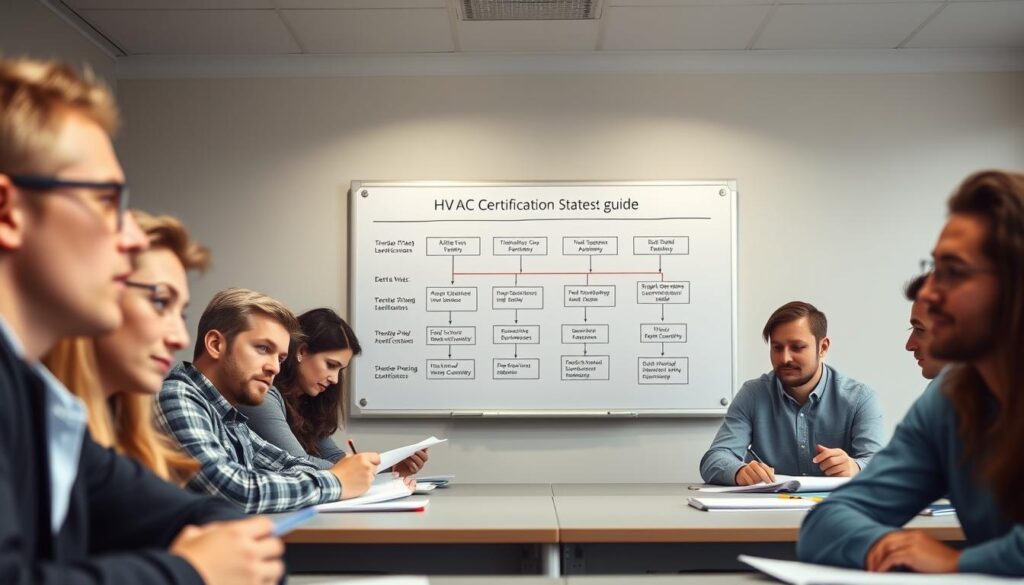
To get your state hvac certification, you must go through a detailed exam and application process. Each state has its own rules, but they all aim to make sure only qualified people work in HVAC.
The licensing exam tests your knowledge in key areas. These include:
- Technical system understanding
- Installation procedures
- Safety regulations
- Energy efficiency standards
- Electrical and mechanical principles
Getting ready for the exam takes hard work and real-world experience. Most states ask you to show:
- At least 2-4 years of work experience
- Completion of technical training
- Passing a detailed written test
- A background check
When you apply, you’ll need to provide important documents. Make sure you have these ready before you start:
- Proof of apprenticeship or work experience
- Educational transcripts
- Professional references
- A completed state application form
- Examination fees
Getting certified is more than just passing a test. It shows you’re dedicated to being the best in HVAC and always learning more.
Explore Our HVAC Shop
Looking for top-rated HVAC tools, parts, and accessories? Visit our shop and find the perfect solution for your needs.
Visit the ShopHVAC License Renewal and Maintenance
Keeping your HVAC contractor license up to date is key. Most states require you to update your license regularly. This ensures you’re current with industry standards and new technologies.
Typical hvac contractor license requirements for renewal include:
- Completing continuing education credits
- Paying renewal fees
- Submitting current professional documentation
- Demonstrating ongoing work experience
The renewal process has several important steps. You must keep track of your license’s expiration date. Start the renewal process early to avoid penalties or a temporary license suspension.
Continuing education is vital for your license. Most states require 4-16 hours of approved training each year. These courses cover:
- Recent technological developments
- Safety protocols
- Energy efficiency standards
- Updated building codes
If you miss the renewal window, don’t worry. Many states offer a grace period to reinstate your license. You might need to take more training or pay a late fee. Contact your state licensing board for details and help.
Proactive license maintenance keeps your HVAC business compliant and competitive.
Conclusion
Starting an HVAC business means you need to know about licenses. It’s key to follow the law and be seen as a pro. You start by learning about state and local rules for HVAC workers.
Every state has its own rules for getting the right licenses. You’ll need to pass tests, get technical certifications, and keep learning. You’ll also need EPA certification, special licenses, and to register your business.
Seeing licenses as important, not just a rule, changes how you view your business. They show you care about quality, safety, and being the best. By learning about licenses, you become a reliable HVAC expert.
Keeping up with new rules and keeping your certifications current is vital. Always learning and adapting will make your business stand out. See the licensing process as a chance to grow and improve.