Affiliate Disclosure
HVAC Guide Guys is a participant in the Amazon Services LLC Associates Program, an affiliate advertising program designed to provide a means for sites to earn advertising fees by advertising and linking to Amazon.
Are you having trouble getting your air conditioning to work its best? Did you know that knowing about subcooling could make your system more efficient and save you money on energy bills?
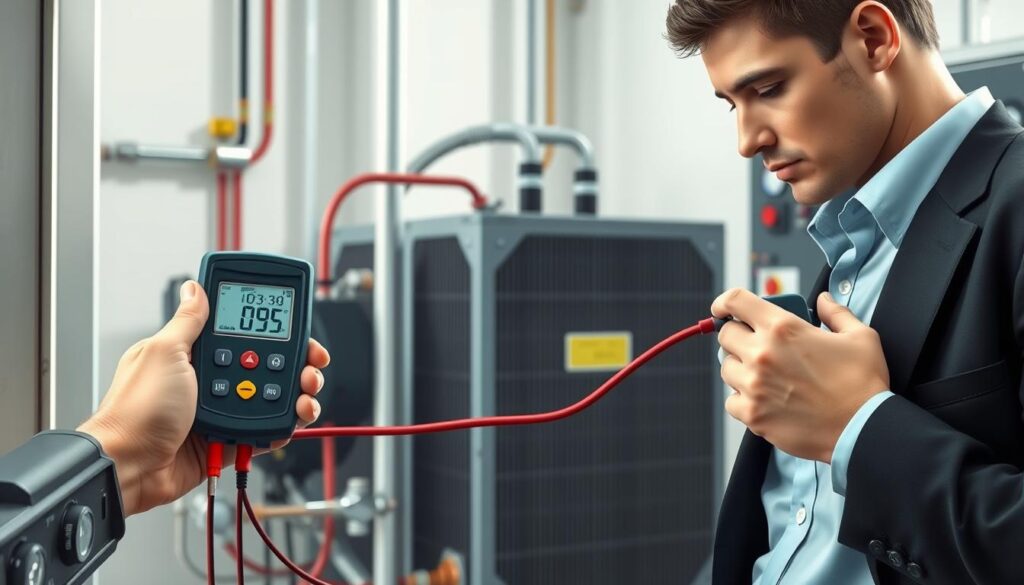
Subcooling is a key measurement that many people miss. It shows how much cooler the refrigerant is than it should be. Knowing this can help spot problems with your HVAC system early on, before they cost a lot to fix.
In this guide, you’ll discover how to measure subcooling accurately. You’ll also learn why it’s important and how it can make your HVAC system work better. These steps are useful for anyone, whether you like to fix things yourself or you’re a professional. They’ll help keep your cooling system running smoothly.
Key Takeaways
- Subcooling is key to knowing how well your HVAC system is working
- Getting the right measurements needs special tools and knowledge
- Good subcooling stops your system from wasting energy
- Checking it regularly can make your HVAC last longer
- Getting help from a pro is best for tricky measurements
Table of Contents
Understanding Subcooling in HVAC Systems
Refrigeration systems need precise thermal management to work well. Subcooling is key for optimal performance and system reliability. This section will cover the basics of subcooling and its importance in HVAC and refrigeration.
What is Subcooling and Why It Matters
Proper subcooling means 100% liquid refrigerant goes into the metering device. This is vital for efficient system operation. It involves cooling the liquid refrigerant below its condensation point, which is a critical step in the refrigeration cycle.
- Defines additional cooling after complete condensation
- Ensures consistent refrigerant state before expansion
- Prevents system performance issues
The Role of Subcooling in Refrigeration Cycles
First, the compressor raises the refrigerant’s pressure and temperature. Then, the hot gas goes to the condenser to release heat to outdoor air. The refrigerant’s temperature drops to the saturation point where condensation starts.
As more heat is removed, the refrigerant keeps condensing until it’s completely liquid. Then, it cools further below saturation—this is your subcooling.
| Refrigeration Stage | Temperature Characteristics |
|---|---|
| Compression | High pressure and temperature |
| Condensation | Temperature drops to saturation point |
| Subcooling | Liquid refrigerant cools below saturation |
How Subcooling Affects System Performance
Subcooling has a big impact on system efficiency. Insufficient subcooling can indicate undercharge. This leads to reduced capacity, longer run times, and possible compressor damage.
On the other hand, too much subcooling might mean overcharge, restricted airflow, or other issues. These problems reduce efficiency.
The refrigerant subcooling method is a reliable way to check system charge, mainly for systems with fixed orifice metering devices. Measuring subcooling is not just about numbers. It’s about making sure your system works efficiently, keeps the right capacity, and avoids expensive breakdowns.
The Difference Between Superheat and Subcooling
It’s important to know the difference between superheat and subcooling for your HVAC system. These terms might seem alike, but they are key parts of the refrigeration cycle. They affect how well your system works.
Superheat and subcooling are important for checking and improving your refrigeration system. Here’s what they are:
- Superheat: This is the temperature of refrigerant gas above its boiling point at a certain pressure.
- Subcooling: This is the temperature of liquid refrigerant below its condensing point.
Let’s look at a comparison to understand these better:
| Characteristic | Superheat | Subcooling |
|---|---|---|
| Location in Cycle | Suction Line | Liquid Line |
| Phase | Gaseous | Liquid |
| Typical Measurement | 10-15 degrees above boiling point | 10-15 degrees below condensing point |
“Proper understanding of superheat and subcooling is the key to maintaining peak HVAC system efficiency.” – HVAC Engineering Professionals
Technicians use these measurements to keep your HVAC system running smoothly. They help avoid damage and save energy. By watching both superheat and subcooling, you can spot problems early and avoid big costs.
Essential Tools for Measuring Subcooling
Measuring subcooling needs special tools for HVAC techs. The right tools give accurate readings and keep your cooling system running well. Professional tools are key to knowing how your HVAC system works.
Refrigerant Manifold Gauges and Their Uses
Refrigerant manifold gauges are key for subcooling checks. They let you watch system pressures and refrigerant levels. They usually have:
- High-side pressure gauge
- Low-side pressure gauge
- Colored hoses for different refrigerant connections
- Manifold valve for precise pressure control
Digital Thermometers and Thermocouple Clamps
Getting the right temperature is key for subcooling. Digital thermometers with thermocouple clamps give quick, exact temperature readings. They’re important for your HVAC system.
| Tool Type | Temperature Range | Accuracy |
|---|---|---|
| Infrared Thermometer | -58°F to 1022°F | ±1.5°F |
| Digital Thermocouple | -328°F to 2192°F | ±0.5°F |
| Clamp-on Thermometer | -40°F to 500°F | ±2°F |
Modern Subcooling Measurement Instruments
New tech has changed subcooling measurement. Modern digital tools offer:
- Wireless connectivity for real-time data
- Better measurement accuracy
- Integrated software for detailed system analysis
- Smartphone app compatibility
Good measurement tools keep your HVAC system at its best. They help spot problems early, saving you money.
How to Find Subcooling HVAC
Measuring subcooling in your HVAC system needs precision and careful preparation. Professional technicians know the key steps for accurate readings and system performance.
Safety is very important when working with refrigeration systems. Always wear safety glasses and gloves when working with refrigerant. Make sure you work in well-ventilated areas and have the right recovery equipment.
Preparing Your HVAC System for Measurement
Before starting your subcooling measurement, follow these important steps:
- Make sure the system is running steadily
- Check that the system has been running for at least 15 minutes
- Ensure all service ports are accessible
- Gather all necessary measurement tools
Connecting to the Discharge Service Valve
The right way to connect your manifold gauge involves several important steps:
- Close the gauge hose valve completely
- Thread the connection onto the service port
- Slowly open the valve to register refrigerant pressure
- Minimize refrigerant loss during connection
Recording Temperature and Pressure Readings
For precise subcooling measurements, follow these key guidelines:
- Attach pipe clamp thermocouple 6-12 inches from service valve
- Position sensor on clean, bare copper surface
- Ensure clamp maintains firm contact without deforming pipe
- Allow 2-3 minutes for temperature stabilization
*Precision is key: Record pressure to the nearest 1 PSI and temperature to the nearest 0.5°F*
Take multiple readings and average them to improve accuracy. This method ensures reliable measurements for calculating HVAC system performance and making informed refrigerant charge adjustments.
Step-by-Step Subcooling Calculation Process
Calculating subcooling needs precision and knowing your HVAC system well. It shows the refrigerant charge status and system performance accurately.
- Identify Refrigerant Type: Find the refrigerant type (R-22, R-410A, R-134a) on the system nameplate or service documents.
- Measure Liquid Line Pressure: Record the liquid line pressure reading with your refrigerant manifold gauges (for example, 278 PSIG).
- Convert Pressure to Saturation Temperature:
- Using an analog gauge with R-410A markings
- Referencing a Pressure-Temperature (PT) chart
- Utilizing a digital tool or smartphone app
- Record Liquid Line Temperature: Use a thermocouple to measure the actual liquid line temperature (for instance, 98°F).
- Calculate Subcooling: Subtract the actual liquid line temperature from the saturation temperature.
Digital tools can make this easier by doing the math for you. Experts say knowing the manual method is key for checking tool accuracy and fixing special problems.
Pro Tip: Always ensure the liquid line temperature is lower than the saturation temperature to prevent system problems.
Watch out for common mistakes, like:
- Using the wrong refrigerant PT charts
- Reading pressure from the wrong gauge
- Measuring temperature too close to the metering device
- Doing subtraction the wrong way
If your system has long refrigerant lines (over 50 feet), you might need to adjust for pressure drop. This could mean measuring pressure at the same temperature spot or adding refrigerant as the manufacturer suggests.
Interpreting Your Subcooling Measurements
Understanding subcooling measurements is key to keeping your HVAC system running well. These indicators show how your system’s refrigerant charge and health are doing.
Proper Subcooling Values for Different Refrigerants
Each refrigerant needs a specific subcooling level. By looking at outdoor temperature and indoor wet bulb, you find the right subcooling range:
- R-22 systems: 8-12°F subcooling
- R-410A systems: 10-15°F subcooling
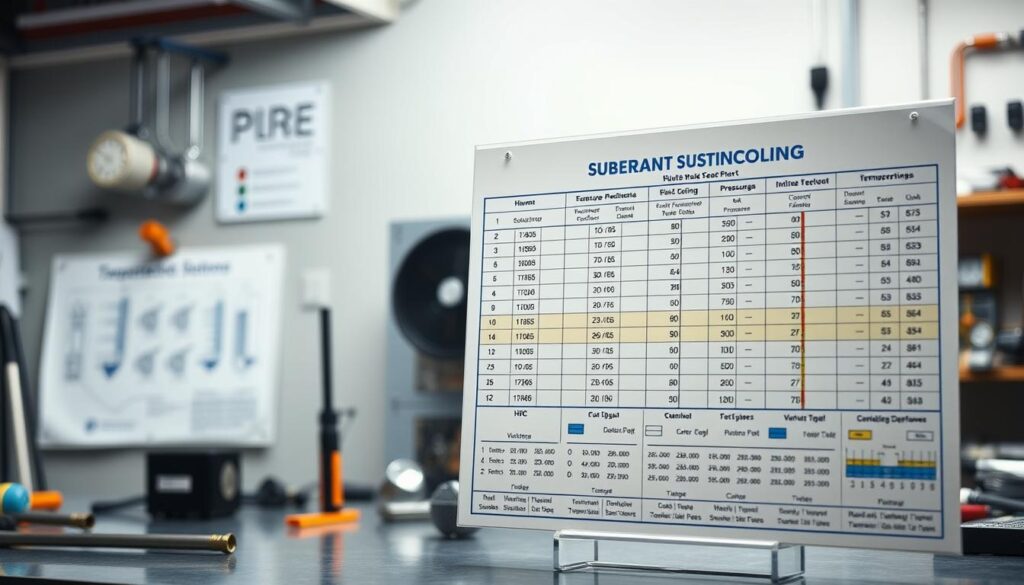
For instance, at 95°F outside and 67°F inside, your chart might say 12°F subcooling is needed. Thermostatic expansion valves (TXVs) keep superheat steady. So, subcooling is the main way to check if the system is charged right.
Signs of Incorrect Refrigerant Charge
Spotting refrigerant charge problems needs careful reading of measurements:
- Low Subcooling (0-3°F)
- Shows a big undercharge
- Symptoms: Low suction pressure
- Risk of compressor damage
- High Subcooling
- Could mean the system has too much refrigerant
- Or there might be airflow problems
- Also affected by outside temperature
“Proper subcooling values are diagnostic indicators that reveal your HVAC system’s true operating condition.”
Keep in mind, a ±3°F difference from the target is usually okay. It accounts for small measurement errors and system variations.
Common Mistakes When Measuring Subcooling
Getting the right subcooling measurement is all about precision and detail. Many HVAC techs make big mistakes that can mess up their system checks and how well it works.
The most common errors include:
- Measuring pressure at the compressor instead of the condenser service valve
- Using tools that are not correctly calibrated
- Recording measurements when the system is not yet at steady state
- Taking measurements at inappropriate locations on the liquid line
One big mistake is the “beer can syndrome”. Techs judge refrigerant charge by feeling the suction line instead of precise measurements. This can cause the system to be overcharged or undercharged, hurting its efficiency and shortening its life.
Bad temperature measurement methods can lead to big errors. Some common mistakes are:
- Holding a temperature probe loosely against a pipe
- Using uninsulated probes that mix ambient and pipe temperatures
- Not waiting long enough for temperature to stabilize
Some techs also assume standard conditions like 50% relative humidity when figuring out target values. But this can lead to wrong subcooling calculations. Always check the real indoor conditions and use the manufacturer’s charging charts for the best results.
Precision matters: There’s no substitute for careful, methodical measurement in HVAC diagnostics.
By knowing and avoiding these common mistakes, you can get more accurate subcooling measurements. This helps keep your HVAC system running at its best.
Troubleshooting Low Subcooling Issues
When your HVAC system shows low subcooling, many things could be wrong. Knowing what these issues are helps you fix problems fast and right.
Identifying Refrigerant Undercharge Problems
Not enough refrigerant is a big problem for your cooling system. Signs include:
- Low subcooling with low suction pressure
- Low superheat in moderate undercharge
- Less cooling power
- Longer times to cool down
- Possible overheating of the compressor
Low subcooling happens when there’s not enough refrigerant. The condenser can’t make a full liquid column. Most of the condenser is used for condensation, not cooling. This means the refrigerant leaves barely liquid.
Detecting Refrigerant Leaks
Finding refrigerant leaks needs careful checking. Look for:
- Oil spots around connections
- Residue at valve cores
- Hissing sounds from escaping refrigerant
- Readings from electronic leak detectors
Thermal Expansion Valve Diagnostics
Thermal expansion valve (TXV) problems can affect subcooling. A stuck-open valve can lead to low subcooling and possible flooding. Look for changing superheat values and check the sensing bulb’s attachment to find TXV issues.
Condenser Airflow Evaluation
Bad airflow can cause unexpected subcooling issues. Check the condenser fan’s operation by looking at motor speed, blade angle, and for blockages. Low discharge pressure might show severe airflow problems.
Just adding refrigerant without fixing the real problem only helps for a little while. Using a systematic way to find and fix low subcooling problems is key.
Troubleshooting High Subcooling Problems
Refrigerant overcharge can cause big problems in HVAC systems. When there’s too much refrigerant, the condenser gets too much liquid. This makes the system work harder and less efficiently.
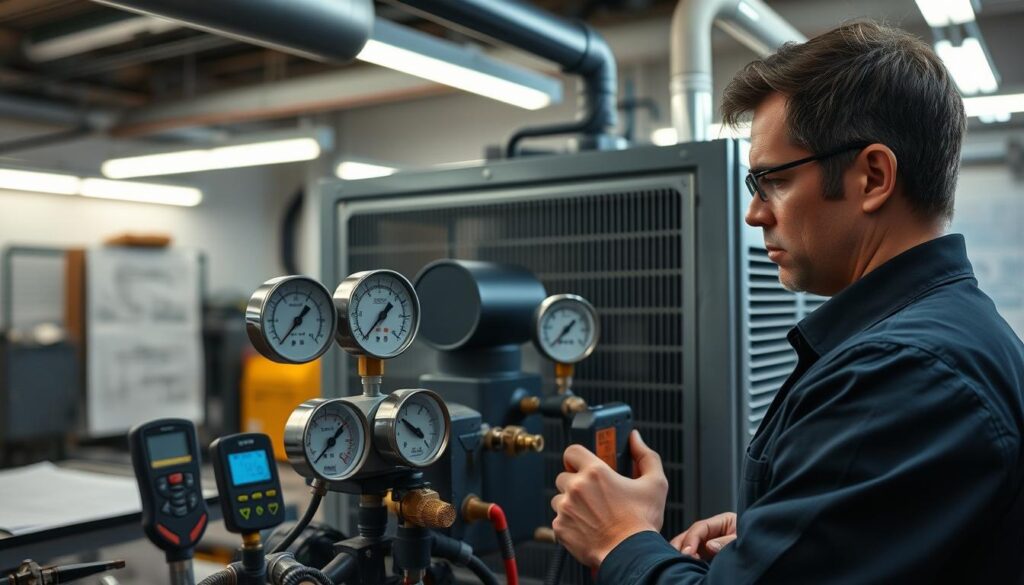
- High subcooling with high head pressure
- Normal or slightly low suction pressure
- Normal to slightly high superheat
- Possible liquid slugging sounds from the compressor
- Reduced cooling efficiency
- Higher-than-normal amp draw on the compressor
Too much refrigerant causes many issues. It reduces the condenser’s surface area for heat release. This makes the system work harder and increases pressure.
| Diagnostic Indicator | Potential Cause |
|---|---|
| High Head Pressure | Excess Refrigerant Volume |
| Elevated Amp Draw | Compressor Strain |
| Reduced Cooling Efficiency | Compromised Heat Transfer |
To confirm overcharge, follow these steps:
- Verify high subcooling with elevated head pressure
- Check suction pressure and superheat
- Confirm elevated amp draw
- Use manufacturer pressure charts for comparison
Fixing overcharge needs special tools. Always use approved refrigerant recovery tools and follow EPA rules. Never release refrigerant into the air during repairs.
Verifying HVAC Charge Accuracy Using Subcooling
Knowing how to check refrigerant charge is key for your HVAC system’s best performance. Accurate subcooling measurements help ensure your system works at its best.
When checking refrigerant charge, manufacturer charts are your go-to guide. At 95°F outside and 67°F indoor wet bulb, the chart says 12°F subcooling for a 024 model unit. There are two main chart types:
- Required Subcooling Charts: Show the target subcooling degrees directly
- Liquid Line Temperature Charts: List required temperatures at certain pressures
Understanding Manufacturer Charging Charts
Charging charts give vital info on refrigerant needs. The tolerance is usually ±3°F. This means if a chart says 12°F subcooling, 9°F to 15°F is okay. Subcooling changes with different conditions:
- Higher outdoor temps need more subcooling
- Indoor humidity affects evaporator load
- Older systems might not have specific charging charts
Adjusting Refrigerant Charge
Before adjusting charge, check the system’s condition:
- Clean condenser coil
- Ensure proper airflow
- Check clean filters
- Make sure service valves are fully open
When adding refrigerant, follow these steps:
- Connect refrigerant cylinder through manifold gauges
- Position cylinder correctly (upright for vapor, inverted for liquid)
- Open valve slowly
- Keep an eye on subcooling
- Add refrigerant in small amounts
Experts say each subcooling degree increase needs about 1-2 oz of refrigerant in homes. Always use approved recovery equipment when removing refrigerant.
Systematic charge verification makes sure your HVAC system works as designed. This prevents callbacks and extends equipment life.
When to Call a Professional HVAC Technician
Knowing when to call a professional HVAC technician can save you time, money, and prevent system damage. Some situations definitely require expert help.
You should seek professional help if:
- You lack EPA certification and proper recovery equipment
- Your system has lost significant refrigerant indicating leaks
- You feel uncomfortable working with pressurized systems
- Your measurements seem contradictory or unclear
- The system shows multiple complex problems
Professional technicians offer key advantages for complex HVAC repairs. Their expertise goes far beyond simple maintenance. They have specialized tools worth thousands and can diagnose issues quickly and accurately.
When hiring an HVAC professional, ask these key questions:
- Do you hold current EPA certifications?
- What experience do you have with my specific system?
- What measurement tools will you use?
- Can you provide customer references?
While DIY maintenance like filter changes and basic cleaning is okay, refrigerant system work needs professional expertise. Your goal is to protect your system’s performance and warranty coverage.
| DIY Safe Tasks | Professional Required Tasks |
|---|---|
| Changing air filters | Refrigerant charge adjustment |
| Cleaning outdoor units | Leak detection and repair |
| Visual system inspection | Complex electrical diagnostics |
By understanding when professional intervention is necessary, you’ll avoid costly mistakes. This ensures your HVAC system operates at peak efficiency.
Conclusion
Learning about subcooling is key for keeping your HVAC system running well. Subcooling is the difference in temperature between the liquid line and the saturation temperature. It shows if your air conditioning or heat pump has the right amount of refrigerant.
Getting good at measuring subcooling takes precision and focus. You’ve learned about the tools you need, like manifold gauges and digital thermometers. You also know the 6-step process to measure it. Remember, understanding subcooling values depends on the context, like outdoor temperatures and system conditions.
Even though you now know more about subcooling, remember it’s a job for professionals. You need EPA certification, state licenses, and training to work with refrigerants. This knowledge helps you talk better with HVAC technicians and make smart choices about your system.
As HVAC tech gets better and rules get stricter, knowing about subcooling will be even more important. It helps save energy, protect the environment, and keep buildings comfortable. Your effort to learn about subcooling helps make HVAC systems more efficient and sustainable.